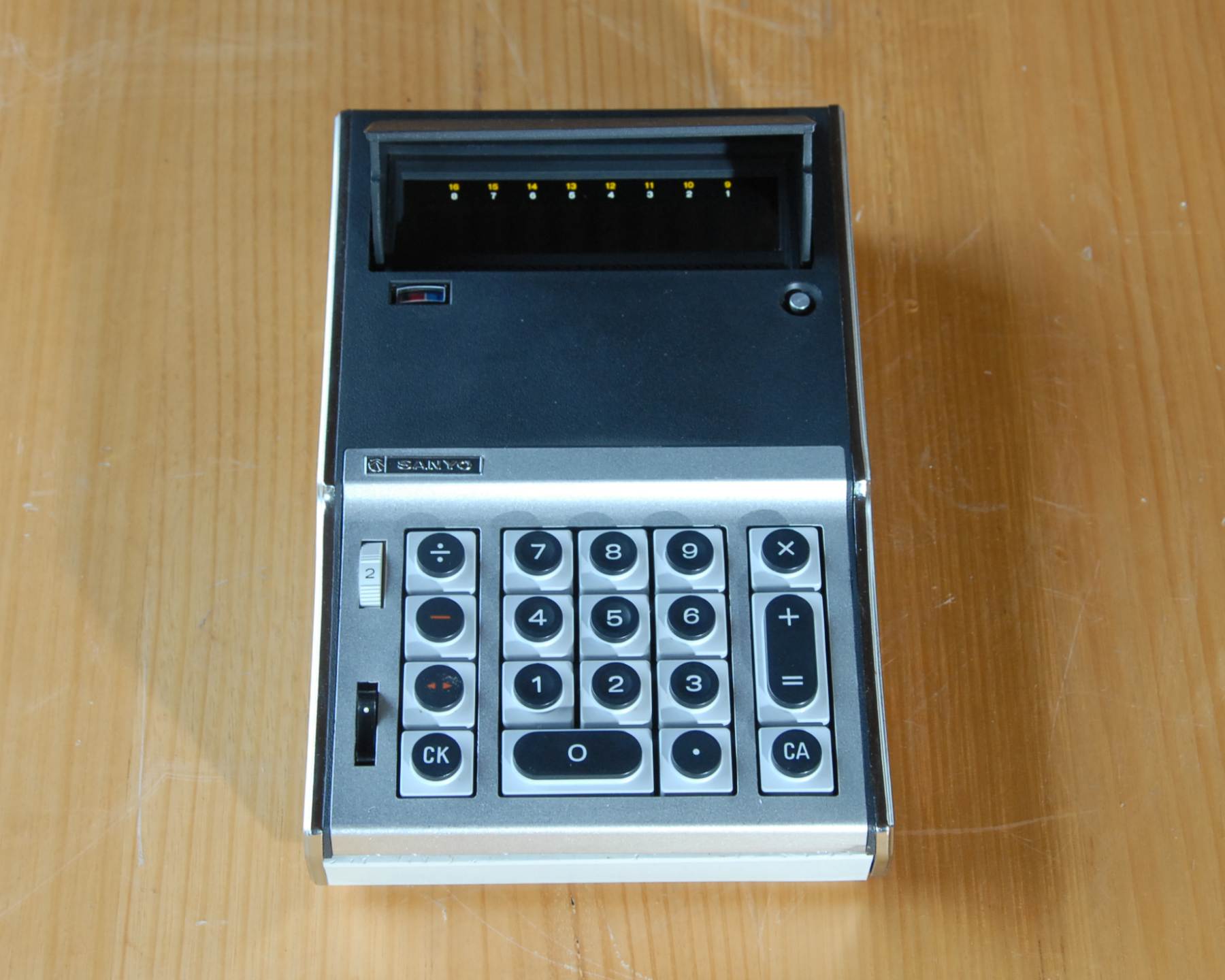
Back to Sanyo OverviewSanyo ICC-82D Calculator
Electronics
Early Japanese MOS LSI calculator chipset by Mitsubishi:
- LM 8001
- LM 8002
- LM 8003
- LM 8005
Display is by eight seven-segment "Eightron" nixie-style tubes.
Architecture, Memory & Speed
16 displayed digits
Digits encoded as 4-bit BCD, serial processing over single-bit internal bus
Shift register memory: 2x 64 bit registers and 3x 16 bit counters
Construction
One double-sided PCB holds the entire calculator circuit, including power supply and display.
The keyboard uses moving magnets and fixed reed switches, a common method carried over from earlier generation machines.
Although the construction has some intricate details such as a pop-up display hood with interlocked power switch it is generally simpler than earlier generation machines, no doubt reflecting the evolving need for consturuction costs to be minimised.
The Parts List document in the Data section has an interesting itemised list of every component with its individual replacement cost in the late 1960s. The LSI chips are the only items not individually priced but it is possible to infer their prices as being around $20 each.
Sanyo ICC-82D
Sanyo ICC-82D