
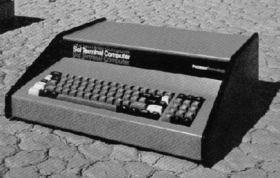
Processor Technology SOL
|
The SOL |
The defects of the original Altair 8800 computer
helped create the supporting industry. Even after the purchaser
laboriously soldered together all its parts and managed to get it working,
the original Altair 8800 computer was little more than a box full of
promises. It consisted of a front panel full of little switches and
lights, and a metal cabinet containing a power supply. The entire computer
portion was one CPU circuit board with the microprocessor chip and a
memory of only 256 bytes (expandable to 1,024 bytes).
To Gary Ingram and Bob Marsh, a couple of friends
from Berkeley, California, the Altair's faults were seen as their
opportunity. Marsh, a member of the Homebrew Computer Club, listened to
complaints at each of the club meetings and determined that one of the
major problems with the Altair was the small amount of memory provided
with the computer kit. The Altair's design did provide for plugging in
additional memory boards, and both 1K and 2K Static Memory Boards and a 4K
Dynamic Memory Board were offered by MITS. However, the 4K memory board
was considered unreliable. Marsh and Ingram decided to form a company,
Processor Technology Incorporated, to produce improvements for the
Altair. The two partners were completely different. Marsh,
a small good-looking man with dark hair and a thick mustache, had an
outgoing personality and a good sense of humor. Gary Ingram was a long
haired, reclusive ascetic. He seldom had anything to say to outsiders. Both were deeply involved with electronics.
Though Marsh had dropped out of engineering school, he worked on the
fringes of the industry. Ingram was employed as an engineer. The partners
developed a wish-list of improved boards for the Altair.
Describing their ideas as already-completed
products, they composed a magazine ad and a hand-out flier, hoping to
generate funds for their enterprise. This was a common practice in those
days. People read ads and would send money to buy "vaporware," products
that were announced and sounded good, but would only be available "real
soon now." In the case of Processor Technology, their ads reaped a harvest
of checks, and the partners were able to rent Lee Felsenstien's garage in
The first product Bob Marsh worked on was a 4K
(4,096 bytes) static memory board. He knew 4K was needed to run the
smallest version of Altair Basic, yet the most glaring defect in the
Altair was the lack of reliable 4K RAM memory. There are two kinds of memory chips used in
constructing computer memories. The Read Only Memory (ROM) chip, once
programmed, retains its information even though you turn off the power.
However, since its memory can not easily be re-programmed, the ROM chip is
only used for information that does not change. Random Access Memory (RAM), the second type of
memory chip, can easily be re-programmed, and so it is the working memory
of the computer. There are two types of RAM memory chips. The most common,
Dynamic Memory (DRAM) needs periodically to be given a pulse of
electricity (refresh) to keep its memory alive. The alternate choice is
Static Memory (SRAM), which consumes more power, but will retain its
information without refresh as long as it is connected to a power source.
Both DRAM and SRAM will lose information once the power is turned
off. MITS had intended to make memory expansion its
first priority, but the expensive 4K dynamic memory board it created did
not work well. The Altair board obtained its essential refresh pulse from
the 8080 microprocessor chip by a process called "cycle stealing." The
problem with this technique is that sometimes the computer chip is off
doing something at a time when the memory needs to be refreshed. If this
happens, the memory "forgets," and data is completely lost! To make "cycle
stealing" work at all, precise timing is required. Timing problems in the Altair 4K board were what
made it defective. Bob Marsh designed the very reliable Processor
Technology 4KRA Memory using static memory (SRAM) chips. It had 4,096 (4K)
bytes of memory, but if you didn't need that huge amount you could buy it
with only 2K, and later add the rest. The 4KRA was priced at $218 in kit
form, or $280 assembled, while the defective MITS board cost $264 in kit
form and $380 assembled. When 8080 computer users read the ads for the
4KRA, they flooded Processor Technology with paid-in-advance orders. The instant success of Processor Technology's 4KRA
was the catalyst that launched the company into business. Bob Marsh and
Gary Ingram moved from their garage workshop into a much larger industrial
facility in Processor Tech's Altair Mother Board After the company's great success with the 4KRA
memory, Marsh turned his attention to another acute but much simpler
problem with the Altair. It badly needed a better motherboard, and MITS
was not going to provide one. When you bought the computer kit, MITS only
supplied a four-slot motherboard and one connector for each plug-in board
ordered. If you originally bought the kit with only the Central Processing
Unit (CPU) card, you only had one installed connector. When you wanted to
put in a memory board, you had to disassemble the computer to solder in
the 100 pins for the next connector. Most owners only went through that
once. They got smart and soldered in all the remaining connectors at one
time. If you wanted to expand your computer with additional plug-in boards, you had to solder in
additional four-slot motherboards and connectors. You really had to be a dedicated hobbyist to go
though that kind of torture. Processor Technology designed an 18-slot
motherboard and sold it for only $35. You could add Altair's full
compliment of 18 connectors (at a cost of $15 each) all at one time. Word
of this improvement quickly spread among Altair owners, and they bought
all the boards Processor Technology could make. The 2K ROM Board Processor Technology offered another product they
thought was needed for the Altair or Imsai, a 2K
ROM board. Loaded with programmed Electrically Programmed read-only Memory
(EPROM) chips, this board allowed the user to start his computer without
flipping countless front panel switches. The board was not much of a
success. It came without the EPROMS, which were difficult to buy and once
bought were beyond the programming ability of most computer hobbyists. In
addition, the computer hobbyists liked to flip the front panel switches.
It was part of the mystique of the computer they were unwilling to share
with the casual user. Almost Free
Software Processor
Technology proposed to supply its customers with "almost free software."
For only $15, it made Software Package #1 available, containing an
assembler, a text editor, and the system executive programs. The utility
programs in this package made it possible for the hobbyists to develop
applications using the additional memory now available. Processor Tech
also promised a low cost version of BASIC, a promise that caused them a
lot of trouble and was not kept for about a year. Computer Mart
Becomes a Dealer Back in
When I expressed interest in becoming a Processor
Technology dealer, Les called Bob Marsh from my store and arranged for my
dealership. As with IMSAI, my main supplier, the financial arrangements
were simple. My order was paid for with cash-in-advance, so the company
could use my money to buy the parts to fill the order. I got most of the
advanced cash from customers. They were so anxious to get the boards, they were willing to pay at least 2/3 of the
price up front just to be placed on my delivery list. Of course, if the
wait was too long, I had to refund the money. But often, no matter how
long the wait, customers chose to leave their deposits rather than take a
chance on being dropped from the list. The best part of becoming a Processor Technology
dealer was that it greatly expanded my customer base. Ed Roberts, head of
MITS, would not let his dealers sell any products that competed with
Altair. My philosophy was directly opposite. My store was the very first
to sell more than one brand of computer, and my policy was to carry all
kinds of computers and accessories. Since I could not sell Altairs, the people who owned them never had occasion
to come into my store. However, with the Processor Technology line Altair
owners flocked in to shop for the products they read about in the
magazines. They bought Processor Tech boards from me as well as chips,
connectors, software, books, and magazines. Two sorely-needed new Processor Tech products
revealed to me by Les Solomon were an input/output board and a Video
Display Module. Until this time the difficult job of getting information
into, or out of, the microcomputers required separate parallel and serial
interface boards. At that time, the main input/output device used
with big computers, minicomputers, and microcomputers was the Teletyper. This wonderful but noisy machine was both a
keyboard-input terminal and an output printer. In addition, many Teletyper models included a paper tape punch which
could be used as the computer's memory storage. Connected to a Teletyper,
your computer could "dump" the program or data in its memory by punching a
pattern of holes into a paper tape. These paper punches could also
duplicate their tapes. As many copies as required could be made, and the
paper tape could then be rolled or folded up and stored in a drawer. In
the early days, punched paper tapes became the principal method of
distributing software, mainly because there was no standard for cassette
tape. For the microcomputer user, the main problem with
the Teletyper was its cost. The Teletype
Corporation sold only to large companies and then only on a yearly
contract. New machines cost about $1,800 (three times as much as the
microcomputers) and were very hard to get. On the re-sale (gray) market,
"used" machines (really, new ones) were sold for as much as $2,500 and
re-built ones for about $1,200. Computer hobbyists tried to find old,
obsolete models to repair and put back into service, but they were
scarce. Even if you had a Teletyper, you still needed a serial interface board
to connect it to the computer. The 3P+S Interface board from Processor
Technology had three parallel ports (3P) for connection of various devices
such as keyboards, printers, and plotting boards. The 3P+S board also had
a serial port (+S) for connection of any kind of Teletyper, no matter how old it was. This was possible
because the 3P+S had hundreds of options, which you could select by
installing various jumper wire combinations. No matter what printers,
terminals or other I/O devices you added in the future, you would never
outgrow the 3P+S. In an effort to provide machines for Altair users,
MITS made a deal with Teletype Corporation. For $1,500, MITS sold a brand
new Teletyper machine that would only work with
their Altair I/O board. Within a few months, the hardware hackers found a
way to interface the Altair/ Teletyper machine
with a 3P+S board. The information quickly became available to all users
through the magazines and computer clubs, rapid conduits for all new
breakthrough information. Selling for only $125 in kit form, the 3P+S
became Processor Technology's best seller. The VDM-1 Video Display Module In 1975, using a video terminal instead of a
printing terminal for computers was a relatively new idea. The video
terminals were sometimes called "glass teletypes." They were expensive.
The price of a video terminal was many times the cost of a personal
computer, so they were only used for large computers In September of 1973, two years
before the Altair appeared, Radio Electronics Magazine had published an
article, "The TV Typewriter" by Don Lancaster, describing how to build a
crude video device. This device used a TV screen to display the characters
which had been typed on a keyboard. Before working for Processor Technology, Lee Felsenstein had been attempting to build a
video-operated "Tom Swift Terminal." Therefore, Marsh and Ingram chose Lee
as the person to build the plug-in video terminal board needed by the
Altair. The Processor Technology VDM-1, as it was called,
was advertised for sale in the first issue of Byte in September of 1975.
Delivery was promised 3 weeks after receipt of order. Processor
Technology, like all the early computer manufacturers, underestimated the
development time required for a proposed product. The VDM-1 was not
actually available until the fall of 1976, and even then delivery might
take up to 60 days after order. When the VDM-1 finally was delivered, it did
everything promised. You could connect a keyboard to the computer through
the 3P+S Board, plug-in your VDM-1, connect it to
a video monitor, and your computer became its own video terminal. The
VDM-1 also ran one of the first action video games. Developed by Steve
Dompier, Target shot arrows at targets moving
across the screen. The video board was almost too good
to be true, with only a few minor faults. A real video display terminal
usually had 80 characters displayed across the screen and could show 24
lines of text. The VDM could display only 64 characters on each line, and
there were only 16 lines of text. A real video display terminal was made,
with special cathode ray tubes (CRT's) and video circuits designed for
that specific purpose. Such CRTs were not available for use with the
VDM-1. You had to use either video monitors designed for closed circuit
television, or converted TV sets. In TV, the picture is "painted" on the
face of the tube by a stream of electrons. It "paints" (scans) one line at
a time. At the end of the line, the electron stream is blanked out and is
returned to the next line. Then it scans across the tube again. This TV
scan rate, which permitted only time enough to display 64 characters by 16
lines, was used as the basis for the VDM-1 design. Since typing margins
are usually set at least The
Time of The SOL The VDM-1 completed the full line of expansion
boards for the Altair/Imsai computers. Processor
Technology now proposed to write an article describing how to build a
video terminal for the Altair. Popular Electronics Magazine agreed to
publish the article and show the completed terminal on the cover, provided
it was ready for photography within 30 days. Bob Marsh hoped a cover story
would assure immediate success for the new product, so he challenged Lee
Felsenstein to undertake the task. Using the
same circuits Processor Tech perfected for their earlier boards, Lee set
to work to meet the deadline. His final design went further than the
requirements for a video terminal. He developed a complete new computer.
This was a different kind of a computer, one designed not for hobbyists
and hackers but for business people who needed useful applications. This
was to be a machine not relegated to a workroom or the basement, but a
computer that could proudly claim a place in a living room or a private
office. The new machine would look somewhat like a modern blue typewriter
with handsome walnut side panels and an excellent keyboard. A friend of Bob Marsh could supply the walnut side
panels for the case, if the computer was designed low enough to fit them.
The height problem was solved by mounting the expansion boards
horizontally rather than vertically. With only room in the case for five
boards, most of the computer functions, including the CPU, video, I/O
ports, and cassette interface, were mounted on a single large PC board
positioned on the bottom of the computer. Felsenstein's design included a completely new
idea, the "personality module." This was a ROM containing various types of
system software which changed the capability of the computer. It could
have a standard operating system, an intelligent text editing system, or a
special operating system designed for a specific job. To effect a change
in personality, all you had to do was plug-in the appropriate module. The stripped-down terminal version Lee designed for
the magazine article had a personality module, but only had limited RAM
memory. It was still more intelligent than most "glass teletypes," so it
was called The SOL Intelligent Terminal. The full version was to come in two styles. The
less expensive one had a simple keyboard and only one slot for expansion.
It was called The SOL-10, and very few were ever built. The second model
was a complete computer with an excellent keyboard and a card cage with
five slots. It was called The SOL-20, and provided enough memory for
general computer applications. When the prototype was complete, the
Processor Technology crew headed for When Bob Marsh revealed the name to me, I called
Les and joked, "They're naming the new machine after you_The LES Intelligent Terminal!"
Solomon was flattered by the honor in spite of the
fact that when Bob Marsh and Lee Felsenstein
arrived with the computer, it did not work. It took two days of intensive
troubleshooting in Les's basement workshop to bring the SOL to life. The article in Popular Electronics
offered a kit version at a very low price and free schematics to all who
asked. Processor Technology, deluged with orders, took almost a year to
fill them. The SOL-20, the full working computer, was introduced at the
Personal Computing '76 show in My store was selected to be one of
the first dealerships to get the SOL. We were a large, well-established
I immediately called the factory for repair
instructions. "Can you wait a few days?" Bob Marsh asked me.
"Sure," I answered. "What's going to happen? Magic?" Three days later, Lee Felsenstein walked into the Computer Mart and asked,
"Where are those dead computers?" A fully operative SOL was important enough to put
the designer on a plane for the first service call. From that time on, all
computers were carefully tested before shipment. We never again received a
SOL that did not work right out of the box. In fact, the SOL became known
as the most reliable machine on the market. By 1977, SOL was the dominant
personal computer in the industry and was the principal product in my
store. In the spring of 1977, Processor
Technology called a "mandatory" dealer's meeting at its headquarters in
Emeryville, and I traveled to While at the meeting, I received several urgent
calls from Steve Jobs asking me to meet him in his garage "factory." He
was so insistent that I took time out to meet him and Steve Wozniak. What
happened there is the subject of another chapter, but two years from that
meeting Apple Computer had replaced Processor Technology as leaders of the
industry. At the Processor Technology meeting, Bob Marsh
described the company's plans to introduce the Diablo disk system. This disk system, which was to sell
for $1,200, was exactly what the dealers needed. The SOL computer was
selling to business people more than home users, and cassettes were not
appropriate for storing business programs and data. Gary Ingram made one
of his rare appearances, and demonstrated the disk system and the PTDOS
operating system. The dealers were also promised larger memory boards and
a new color video board. Business was so good that Processor Technology
announced it would no longer require cash in advance. Qualified dealers
could now place orders and pay COD. Thirty-day credit terms were promised
in the near future. Dealers had to submit an order every three months, and
for larger orders there would be an increasing scale of discounts. We all
left Emeryville with a feeling of confidence that both Processor
Technology and our dealerships were well on the road to legitimacy,
leaving behind the "hobbyists" stigma and emerging as a real computer
business. When I returned to
But the picture wasn't quite as rosy as it seemed
for Processor Technology. The Diablo Company, whose main business was
daisy wheel printers, was purchased by Xerox Corporation, and the
development of Diablo's floppy disk drives was stopped. Most of Processor
Technology's work on the floppy disk drive system was lost. They were back
to square one using cassette tape storage. Marsh and Ingram's answer to this problem was to
adopt a new disk drive just coming on the market, the Persci 270. A new and untried device, it drove two
8-inch floppy disks with one motor. The basic idea was to obtain twice the
disk storage at less than the price of two drives. The new Processor
Technology floppy disk system, called Helios, consisted of a cabinet
containing the Persci 270 (with two drives in
one assembly), the power supply and cables. The PTDOS disk operating
system was included. The cost, $1,895, was later raised to $2,300. For a while Processor Technology continued to grow,
and the dealers prospered. Then Radio Shack came out with its TRS-80 Model
I at half the price of the SOL. They eventually developed a disk drive and
the TRSDOS operating system. The Apple II appeared and quickly became very
popular. The Apple II sold for much less than the SOL, could do graphics
in color, and had an ever growing library of software. Its drawbacks were
a 40-column screen and the lack of upper/lower case characters. In spite
of these drawbacks, when Steve Wozniak developed an inexpensive and
reliable floppy disk drive for the Apple II, it soon outsold the SOL. At Processor Technology, the partners were
mesmerized by the success of their company. They became aloof, less
available to the dealers, and appeared not to be interested in their
problems. Lee Felsenstein urged them to improve
their products, but, except for larger memory boards, no new products were
under development, and no attempt was made to upgrade the SOL to keep it
ahead of its rivals. The promised color video board was never delivered
and neither was the promised improved BASIC. Though Chuck Grant and Mark
Greenberg, owners of North Star Computers, had been under contract to
Processor Technology to develop a version of BASIC for the SOL, North
Star, claiming that their agreement was non-exclusive, sold it to other
computer manufacturers. Processor Technology was under the impression that
the BASIC was exclusively theirs, sued, and lost the case after a long
litigation that hurt both companies. In spite of the growing problems,
Processor Technology moved south to a much larger plant in
Meanwhile, North Star developed a
new, low-cost, mini-floppy disk drive system that would work with the SOL.
Coming
with its own operating system, the disk cost less than half the price of
the Helios. Back in
When he started, Larry did not realize he had
undertaken a tremendous task. He was a wealthy young man who hung out
first at my computer store, and then at Bob Radcliffe's Hoboken Computer Works. Radcliffe, a former Bell Labs engineer, urged Larry to
try this difficult job as a way of learning about programming and computer
hardware at the same time. As Larry progressed with Bob's help, it became
apparent that the job would succeed. To sell the product, Larry first sold "program
patches" to CP/M owners that allowed them to run their CP/M software on
the North Star 5 1/2" drives. Then, at the suggestion of Tony Gold, who
ran the CP/M Users Group, Tony and Larry formed a business called Lifeboat
Associates because they were "all in the same boat." The partners licensed
CP/M from Digital Research Incorporated and produced a new North Star 5
1/2" Drive version of CP/M. If Processor Technology had adopted the North
Star floppy disk system, it might have avoided additional trouble.
However, because of the past legal problems, the partners refused to even
consider it. They kept trying to sell the Helios disk system to their
dealers. Problems with Helios started to surface almost at once. Although
much faster than most of the other 8-inch disk drives being sold, the
Persci 270 was very sensitive, difficult to keep
in alignment, and if moved, might lose alignment and stop working.
Unfortunately, these problems only surfaced after Processor Technology
spent thousands on development and manufacture, and had shipped the Helios
to several dealers. It was too late to switch to another drive. In addition, many people, including the dealers,
urged Marsh and Ingram to abandon PTDOS, their proprietary operating
system, and adopt CP/M. The partners refused to listen, certain that their
system would be much better. When their pleas and recommendations went unheeded,
the dealers became less and less interested in the Helios. They could sell
the North Star disk drives and ignore the undependable, expensive
Helios. For the next year most of the dealers sold SOL computers with
North Star disk drives and CP/M from Lifeboat. This made business
applications possible. If you included a daisy wheel
printer and either WordStar or Michael Shrayer's
Electric Pencil, the SOL became an efficient word processing system that
only cost $3,500. In those days, an equivalent dedicated word
processing system cost $10,000. Soon other disk drive systems made by
George Morrow, Micromation and Micropolis came on the market and could also be used
with the SOL and CP/M. Thus, SOL dealers who ignored Processor Tech's
Helios disk and its oddball software prospered, but dealers who sold the
Helios found themselves in trouble because of constant failures. In my
case, one of the few Helios I sold resulted in a lawsuit by my customer
against Processor Technology, one of many such cases throughout the
country. Until suit was brought, Helios customers could not even get the
principals at Processor Tech to discuss the problem. Marsh and Ingram
would listen to no one. As if the problems with the Helios drives were not
bad enough, Processor Technology finally came out with a new line of
dynamic 32K and 64K memory boards. These boards used new dynamic memory
chips rather than the static memory used in the original Processor
Technology memory boards. The required refresh cycles for the dynamic
memory chips were generated on the board itself. This procedure supposedly
made them "safe" from the problems associated with the original "cycle
stealing" dynamic memory boards. But all at once, all over the country,
these new memory boards began to fail. At first, Processor Tech replaced
the defective boards, but the problem soon became overwhelming. When
dealers sent in defective memory boards for replacement, none were
returned. Relationships with the dealers became more
strained. It became harder and harder to communicate problems to the
partners, yet people on the lower level were not given the power to make
decisions. To keep my dealership, Processor Technology
required that I send in an order every three months, but, since I (and
other dealers) were selling more and more Apple
II's and less SOLs,
our inventory of SOL boards and computers grew until it reached almost
$100,000. I became very concerned and tried to talk to the company about
my problem. I knew I couldn't afford to buy any more, and I wanted to run
a sale to convert this excess inventory into much-needed cash. When the
ordering period came, I declined to order anything, and Processor Tech
pulled my dealership. In answer to this, I prepared an ad for Byte and
several other magazines saying "SO LONG SOL" and announcing a clearance
sale at 50% off. When Processor Technology heard about it, the partners
called and begged me to take back my dealership.
Gary Ingram himself said, "It all was a terrible
mistake. Please don't drop the line." They
would help me reduce my inventory by selling it to other dealers. Because
of our close relationship in the past, I agreed and canceled the ads. But
my problems were only typical of the trouble at Processor Technology. The
accumulated mistakes and the unresolved problems, compounded by the
inaccessibility of the owners, proved to be overwhelming. On
Lee Felsenstein went on
to design the Osborne 1 Computer, Bob Marsh went into business building
mini floppy disk drives for the Osborne Computers, and Gary Ingram
completely disappeared from the industry. But the thousands of SOL
computers did not disappear; they survived and were used for years by
their owners until they could not be maintained any
longer.
|