Back to Wang OverviewWang 360E Calculator
Electronics
Discrete diode-transistor circuits, harwired logic.
Architecture, Memory & Speed
10 displayed digits, 1 sign digit and one decimal position digit = 12 digits used in a 16 digit word
Digits encoded as 4-bit BCD, digit-serial processing over 4-bit internal bus
Core memory, 4 registers x 16 digits x 4 bits = 256 cores
Construction
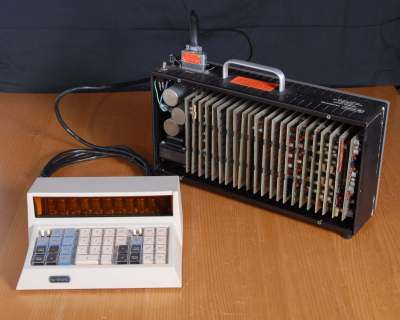
The 300 series were presented as a briefcase-sized electronics unit and a desktop keyboard/display unit. The desktop units could incorporate some intelligence, particularly the means to memorise keystroke sequences, and this allowed extended functions such as keyboards with automatic replay of sequences for trigonometric functions.
The keyboards used the same utilitarian short travel microswitch buttons as the LOCI machines. The keyboard electronics consisted of a diode encoding array for keystrokes and binary decoders for display digits and digit positions.
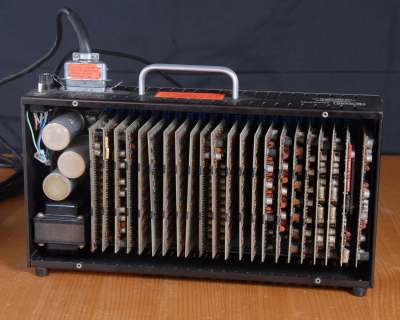
The electronics units were constructed with a backplane that plugged many smallish double-sided boards. This arrangement may have reflected Dr Wang's original 1950s development of a family of custom electronic logic building blocks and indeed Wang calculator circuit boards are always known as "Logiblocs" in Wang literature. The arrangement may have offered some advantage of modularity and field repair by simple board swapping but over time this has been offset by deterioration in the many edge connector contacts, which Wang always declined to gold plate. Poor electrical connections are now a common source of problems in old machines and some care is required in their treatment, so as to avoid causing further degrading the contacts.
The 360E electronics package contains 25 3 inch by 5 inch Logiblocs, each holding 10-30 tranisitors and 20-100 diodes. The Logiblock term is perhaps a bit misleading as the boards are not at all generic in function, and in many cases particular functions are spread across multiple boards.
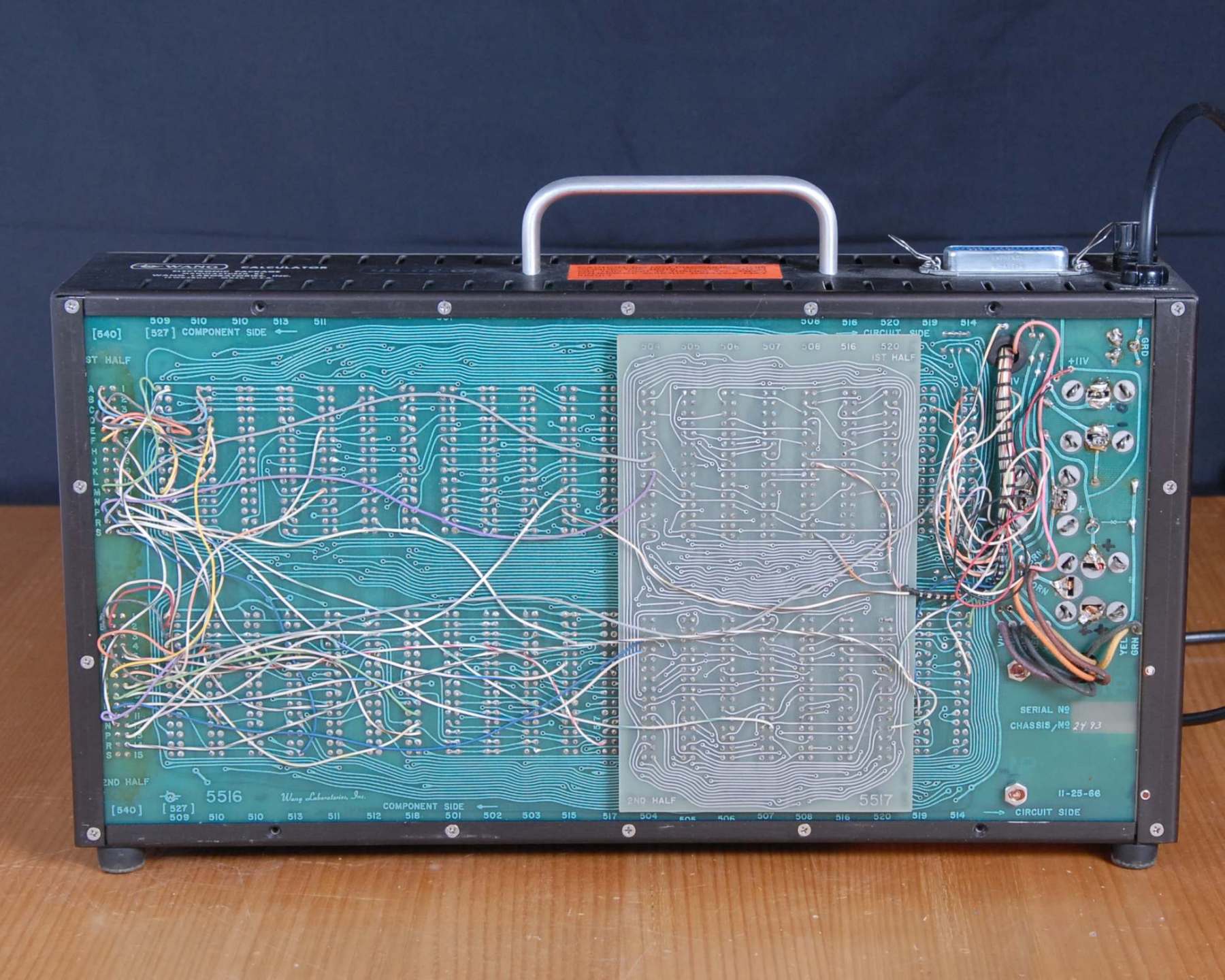
The 360E backplane is a double-sided printed circuit with a second printed circuit stacked at one end to create an early 4-layer backplane. Interestingly, at the other end from this sophisticated part of the backplane, board 540 (Core Drive) is mounted in a location that looks as if it were squeezed in and is wired with flying leads. For those struggling to trace signals across this backplane, an interactive tool based on a spreadsheet is available in the Data&Links section.
The power supply is a basic transformer design, the main logic supplies are 0v and -11v with a +11v bias and +250v Nixie supply. There is no regulation on these supplies but a regulated +/- 5.1v level is developed locally for the core memory and master clock.
Wang 360E Calculator
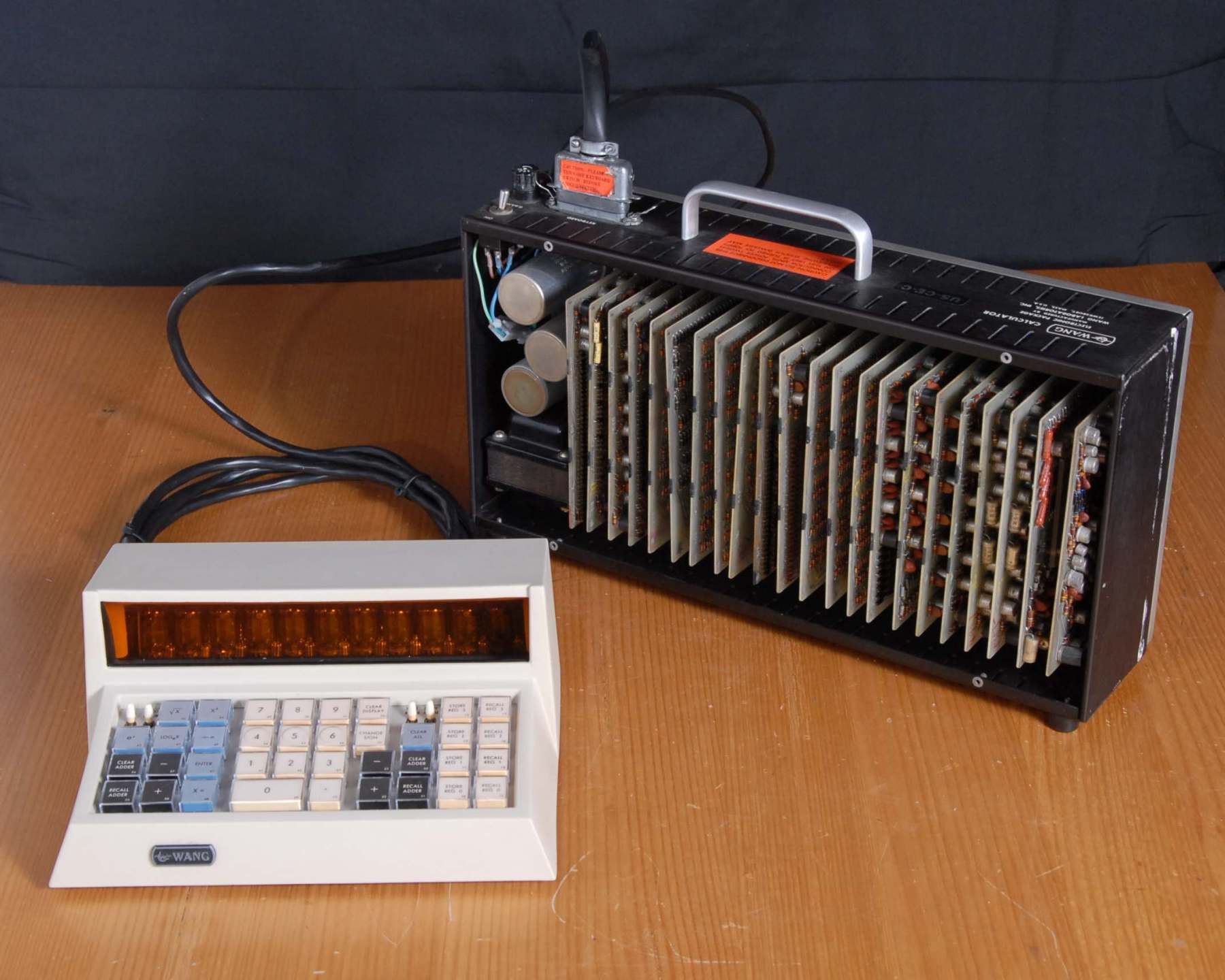
Wang 360E Calculator
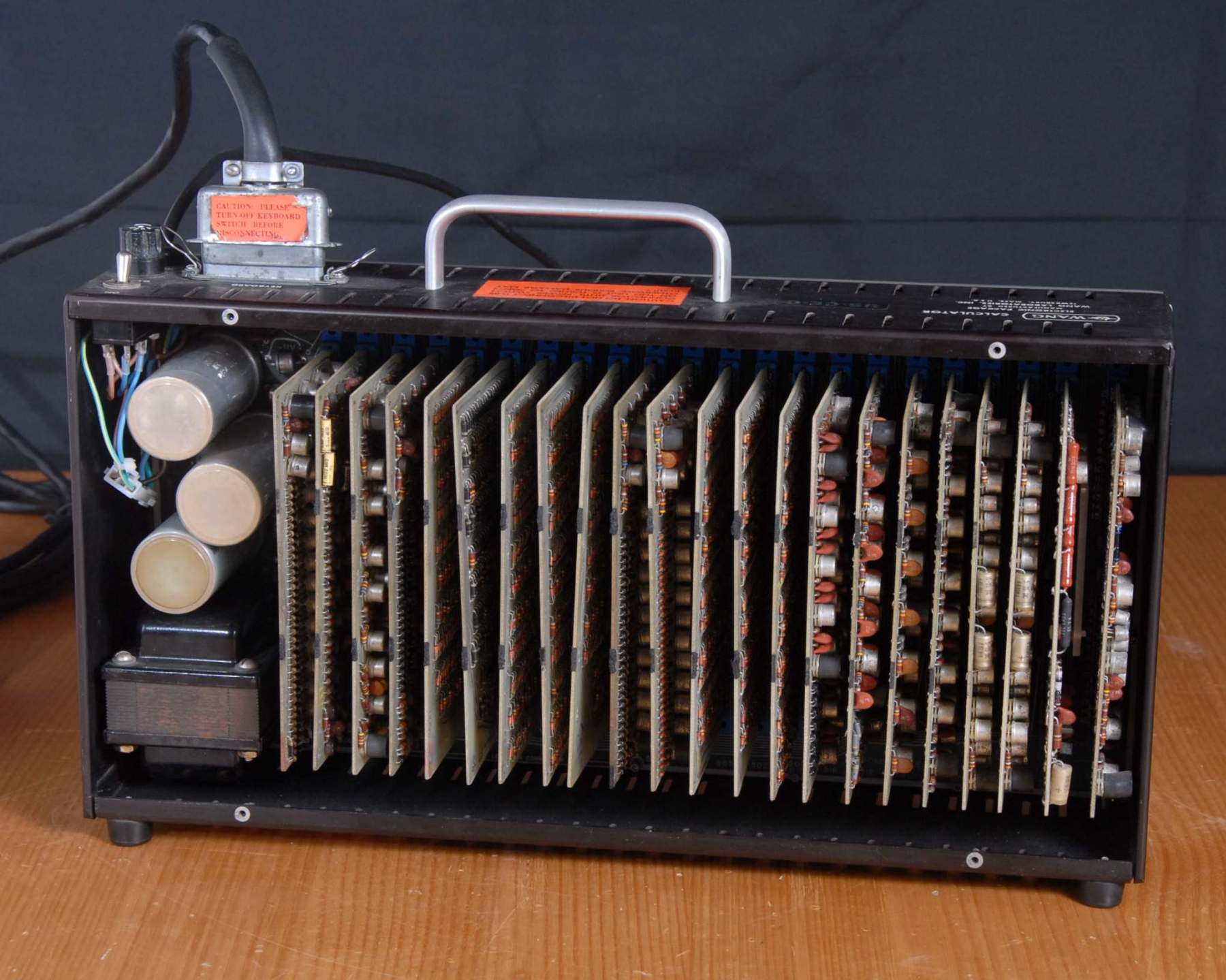
Wang 360E Calculator